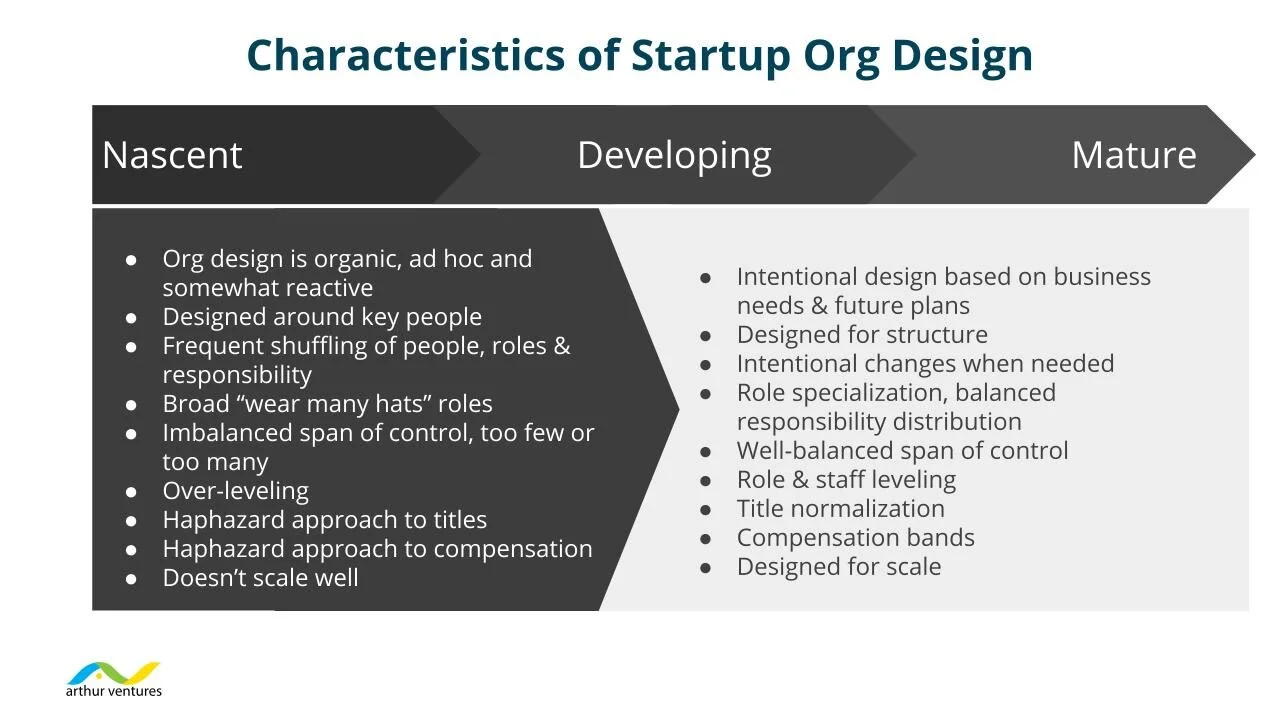
In the early days of a high-growth startup, the organization isn't intentionally designed as much as it is cobbled together based on what is most pressing at the moment. Teams tend to organically sprout up. Roles are added too soon, too late, and when the stars align, at just the right time.
As soon as you have a team or function formed, the needs of the business have evolved and you need to switch people around in their roles and reporting lines. It's a constant evolution.
So, the phrase "Startup Org Design" is probably an oxymoron. And that's totally ok. Part of the fun of startup life is the chaos, constant change, and solving new problems every time you think you've got 'things figured out'.
But as a company scales it can be critically important to start to move towards a more intentional approach to organizational design. It doesn't have to be rigid or overly formal. But being more methodical helps the company run more efficiently.
At some point during a company’s growth trajectory, it comes time to sit down and think about the organizational structure and how it should be designed. From that point forward, org design usually becomes something that is evaluated at a regular cadence. In hyper-growth situations, it may be as frequently as every six months. In other companies, every 12-24 months is probably best.
"Org design gets the right people in the right places, empowers them to make decisions and then holds them accountable for their results." - An Elegant Puzzle
The above definition from An Elegant Puzzle (a fantastic book on engineering management) emphasizes that org design isn't just putting people into departments and determining reporting lines. The purpose of org design is really to empower people to do great work.
Formally, the six elements of org design include:
Taking the elements of org design into account, you can see how it's more than departments and reporting lines—it's how the company, functions, teams, roles, and people work together as a unified organism.
Startup org design evolves as the company evolves. Well, hopefully, it does.
As a startup grows, elements of the early days peel off, and there is a shift towards maturity. It doesn't happen overnight (nor does it need to). And it doesn't happen accidentally. In order to evolve, we have to be intentional and prioritize creating a healthy, productive organization.